For CIOs, CISOs, and IT decision-makers navigating the shift from AI experimentation to enterprise-scale execution in 2026.
Last week, I had a conversation with a close friend who works in IT that stuck with me.
We weren’t debating whether AI works anymore. What we were really unpacking was something more interesting: how dramatically his day-to-day job had changed over the past year, and how his company’s AI journey quietly moved from “experiments” to something far more consequential.
In 2024, they were running pilots. Testing tools. Exploring use cases. In 2025, it became more operational. Embedded. Measured. Accountable.
That shift, from experimentation to execution, isn’t unique to my friend's company. It’s happening across industries. And the data confirms it: organisations that moved beyond assistive AI and into agentic, production-grade systems are seeing materially higher ROI, faster decision-making, and entirely new operating models.
This article kicks off a 2-part series where I’ll explore:
- Part 1: What really changed in 2025 and why AI “got real” for enterprises.
- Part 2: The strategic AI insights shaping 2026 & A practical 90-day playbook to help leaders move from intent to impact.
If 2024 was the year of AI curiosity, 2025 was the year of proof. And 2026 will belong to those who know how to scale it safely, strategically, and deliberately.
The Year AI Got Real
2025 wasn't the year AI became smarter. It was the year organisations figured out how to actually use it.
The numbers tell a story that's hard to ignore. Enterprise AI spending didn't just grow. In fact, it exploded from $11.5 billion to $37 billion, a 3.2x increase that signals something far more significant than hype. This wasn't money thrown at proof-of-concepts. It was investment in production systems delivering measurable returns.
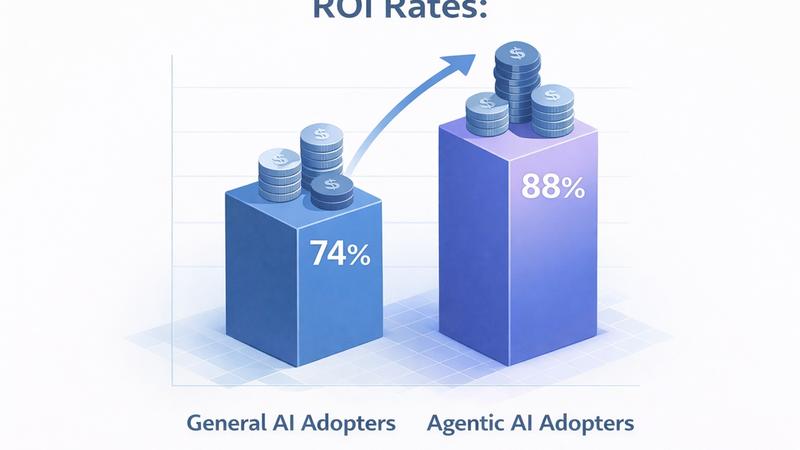
According to comprehensive research from Google Cloud, 74% of organisations saw positive ROI on at least one generative AI use case in 2025. But here's where it gets interesting: early adopters of agentic AI (those systems that don't just assist but actually execute tasks independently ) reported an 88% ROI rate.
Think about that for a moment. While mainstream AI adoption achieved respectable returns, organisations that pushed into agentic territory nearly guaranteed success.
The Agentic Inflection Point
If you're wondering what separated the winners from the other runners in 2025, one word captures it: agents.
By year's end, 52% of organisations using generative AI had deployed AI agents in production. Not pilot programs. Not experiments. Production systems handling real work, making real decisions, anddelivering real value.
And 39% of these organisations? They were running more than 10 agents simultaneously.
This represented a fundamental shift in how enterprises thought about AI. Instead of viewing it as a sophisticated autocomplete or research assistant, leading organisations recognized AI agents as digital team members capable of managing entire workflows starting from customer service inquiries to security threat detection to marketing campaign optimization.
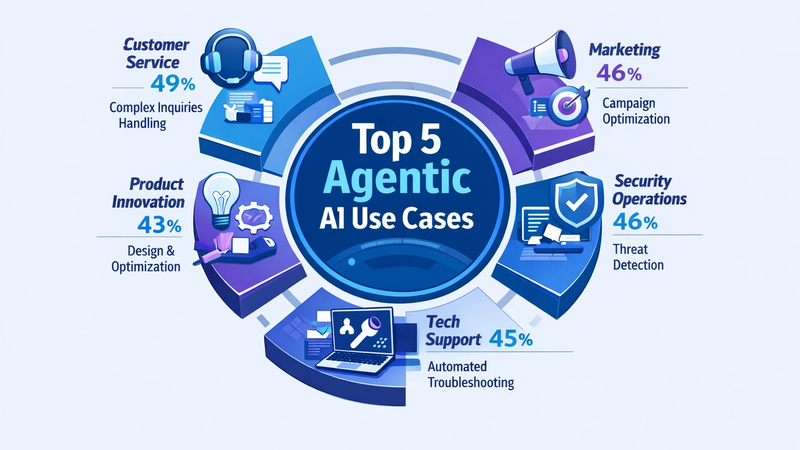
The most common agentic applications that took off in 2025 were:
- Customer service (49% adoption) - Handling complex inquiries that traditional chatbots couldn't touch.
- Marketing (46%) - From competitor research to content creation to campaign optimization.
- Security operations (46%) - Identifying threats and coordinating responses faster than human teams alone.
- Tech support (45%) - Diagnosing issues and implementing fixes with minimal human intervention.
- Product innovation (43%) - Accelerating design iterations and identifying optimization opportunities.
The Global AI Adoption Map: Winners and Laggards
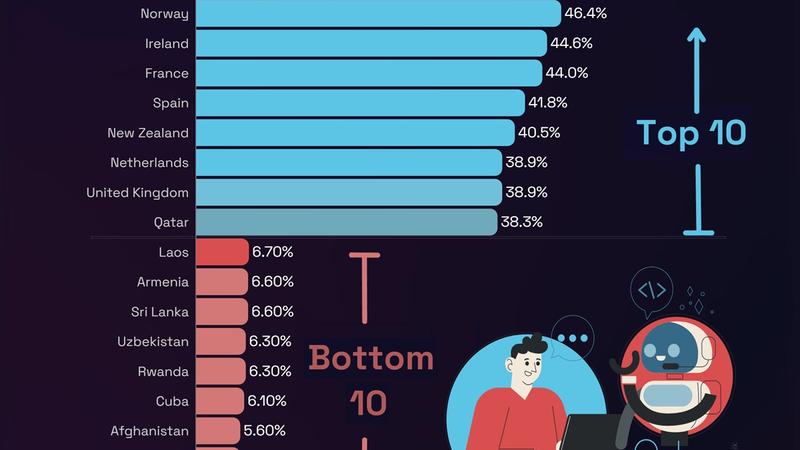
While enterprise adoption surged, the geographic distribution revealed fascinating insights about digital readiness and innovation culture. According to Microsoft Global AI Adoption report in 2025, the global average for AI adoption sat at just 16%. But certain countries shattered this baseline:
- The UAE led the world at 64% adoption. followed by Singapore at 60.9% - not by accident, but through deliberate government investment and aggressively pro-innovation policies. When your national strategy prioritizes AI transformation, it shows.
- Norway hit 46.4%, leveraging its digitally mature infrastructure and high trust in technology.
- Ireland reached 44.6%, capitalizing on its position as Europe's tech hub.
- France (44%) and Spain (41.8%) rounded out the top five, all crossing the critical 30% threshold.
Why does 30% matter? Because markets exceeding this adoption rate fundamentally transformed into"AI-first economies" which we can view as environments where customer expectations, competitive dynamics, and business models assume AI capabilities as baseline requirements, not differentiators.
Five Areas Where AI Delivered Value
Let's cut through the noise and look at where AI actually moved the needle in 2025.
1. Productivity: The Efficiency Multiplier
70% of executives reported meaningful productivity improvements, with 39% seeing employee productivity at least double in specific functions. Not 10% gains. Not 20% improvements. Doubled.
As an example, organisations using Google Cloud's AI tools achieved :
- 50% more productive developers
- 36% more productive end users
- Average time-to-market cut to 3-6 months from idea to production
One particularly revealing metric: companies reduced average development cycles from months to weeks by deploying AI agents that could write, test, and debug code with human oversight rather than constant human intervention.
2. Customer Experience: The Surprise Winner
Here's what caught many by surprise: customer experience wasn't just important. Instead it was the fastest-growing area of AI impact, with 63% of organisations reporting improvements (up from 60% in 2024).
The results were tangible:
- 83% saw increased user engagement across metrics like click-through rates and time on site
- 75% reported improved customer satisfaction scores
- 37% achieved ROI specifically on customer experience use cases
For example, let's consider the case of a major retailer that deployed an AI agent for customer support. Instead of routing simple questions to chatbots and complex ones to humans, their agent handled both by understanding context, accessing order history, processing returns, and even making judgment calls on customer satisfaction credits. Customer wait times dropped 60%. Satisfaction scores climbed 23%. And support costs fell by millions annually.
3. Business Growth: The Revenue Impact
According to Google Cloud ROI of AI study ,among organisations reporting business growth from AI, 53% experienced revenue increases of 6-10%. Another 31% saw gains exceeding 10%.
Put differently: more than half of successful AI adopters added 6-10% to their top line. In a mature economy, that's transformational.
IDC research found that businesses using Google Cloud's generative AI achieved an average of $1.4million in additional net revenue. For mid-sized enterprises, that's a game-changer. For large organisations with multiple deployments, the compound effect is extraordinary.
4. Marketing: The Creative Accelerator
According to many studies including Salesforce State of Marketing report 2025, 55% of organisations reported meaningful marketing impact in 2025, with AI transforming campaign creation, lead generation, and conversion optimization.
The velocity gains were particularly striking:
- 46% faster content creation
- 42% better tone-of-voice replication
- 32% quicker content editing
But the real value wasn't speed. It was scale with personalisation. Marketing teams that previously created one version of a campaign could now generate hundreds of variations, each optimized for specific audience segments, channels, and contexts. The result? Higher engagement, better conversion, and marketing ROI that finally made CFOs smile.
5. Security: The 24/7 Sentinel
According to multiple security vendor studies, roughly 49% of organisations reported improved security posture through AI, with results that traditional security teams couldn't match:
- 77% achieved better threat identification
- 74% improved intelligence and response integration
- 61% cut time-to-resolution for security incidents
The game-changer? AI security agents don't sleep, don't take vacations, and don't miss patterns across millions of data points. They identified threats that human analysts would take hours or days to catch and they did it in seconds.
One financial services CISO put it bluntly: "We're not replacing our security team. We're giving them superpowers. Our AI agents monitor, detect, and alert. Our humans validate, decide, and act. Together,they're unbeatable."
The C-Suite Factor: Leadership as ROI Multiplier
Here's a pattern that emerged with absolute clarity in 2025: executive sponsorship wasn't just helpful for AI success. It was determinative.
According to Wharton Human AI Research & GBK Collective , in 2025, organisations with comprehensive C-level sponsorship achieved:
- 78% saw ROI on at least one generative AI use case (versus 72% without).
- 61% established Chief AI Officer roles.
- 73% reported strong alignment between AI adoption and business goals (up from 69% in 2024).
The difference between successful and struggling AI programs? It wasn't technology sophistication. It wasn't budget size. It was whether the CEO, CFO, and board truly understood and championed AI as strategic imperative rather than IT initiative.
One healthcare CIO captured it perfectly: "The moment our CEO started asking 'how is AI helping us serve patients better?' instead of 'how much are we spending on AI? is that's when everything changed."
The Investment Reality: Where the Money Went
Still according to Wharton Human AI Research & GBK Collective, the financial commitment to AI in 2025 revealed organisations moving past experimentation:
- Average AI allocation hit 26% of total annual IT spend.
- 77% of organisations increased AI spending even as technology costs decreased.
- 48% reallocated budgets from other IT initiatives to fund AI (up from 44% in 2024).
This last point matters. Organisations weren't just finding extra money for AI. Instead they were making active choices to fund AI instead of other technology investments. That's conviction, not curiosity.
The top investment priorities for 2025 were:
- Aligning business and technology for change management (42%)
- Enhancing data quality and knowledge management (41%)
- Upskilling staff and developing partnerships (40%)
- Providing proper tooling and compute resources (37%)
- Governing and managing AI risk (33%)
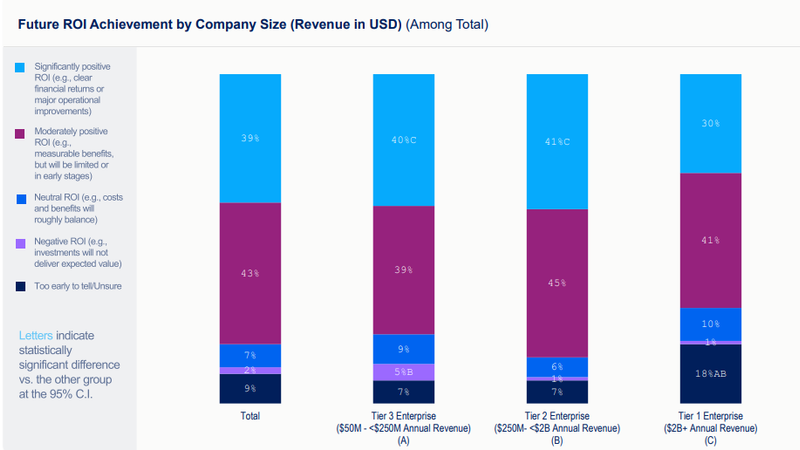
Looking forward, 87% of leaders remain confident that returns will accelerate over the next two to five years, and 88% expect budgets to increase in the next year.
The Hard Truth: 70-85% of AI Projects Still Fail
For all the success stories, 2025 also delivered a sobering reality check: 70-85% of AI projects still failed. Why? The obstacles were predictable but persistent. Here are some of them.
Trust and Accuracy Concerns
77% of businesses worried about AI hallucinations, with 47% of enterprise AI users having made at least one major decision based on hallucinated content in 2024. This led 76% of enterprises to implement human-in-the-loop processes which by consequent is adding cost, complexity, and time to every AI workflow.
Data Privacy and Security
Over one-third of organisations ranked data privacy and security as their top concern when evaluating AI providers in comparison to integration (28%) and cost (27%). And they were right to worry. The average AI-associated data breach cost $650,000, with many incidents involving exposure of customer PII or intellectual property.
Integration Complexity
Legacy systems weren't built for AI. Connecting modern AI tools to decades-old infrastructure while maintaining security, governance, and performance proved far harder than most organisations anticipated.
Skills Gaps
60% of employees said hands-on learning would boost their AI usage , yet most organisations provided minimal training. The result? Underutilization of expensive tools and workers reverting to familiar (unsanctioned) solutions aka Shadow AI.
The $650,000 Problem: Shadow AI Explodes
Now here's the uncomfortable truth that defined 2025: while official AI adoption surged, shadow AI usage absolutely exploded.
Research from Menlo Security, uncovered a 68% surge in shadow AI, with web traffic to GenAI sites hitting 10.53 billion visits in January 2025 alone.
The statistics are sobering:
- 98% of organisations had employees using unsanctioned AI apps.
- 78% of AI users brought their own tools to work such as ChatGPT on personal accounts, Claude through personal logins, Midjourney for "quick" design work
- 57% of employees using free-tier AI tools input sensitive company data
- AI-associated data breaches cost organizations more than $650,000 on average
Think about what this means: your employees are already using AI extensively. They're just not using your AI.
IBM research revealed that 80% of workers use AI in their roles, but only 22% rely exclusively on company-provided tools. That's a 58-point gap between actual usage and governed usage. The perfect storm for data exposure, compliance violations, and competitive vulnerability.
The irony? Employees weren't being rebellious. They were being resourceful.
As one IT director told us:"We told people AI would transform their jobs, then gave them tools that barely worked. Of course they went elsewhere."
In summary 2025 marked a pivotal year where AI transitioned from experimentation to enterprise-scale execution, with agentic AI and governance emerging as key drivers of success.
In next week article, I will be sharing my takes on the strategic AI insights shaping 2026 & a practical 90-day playbook to help leaders move from intent to impact.
In the meantime, I am inviting you to learn about Aona AI and discover our solutions to help your organisation transform AI governance burden into an accelerator.
About Aona AI: Aona AI is the leading enterprise responsible AI adoption platform that empowers organisations to use AI safely. Our solutions provide the visibility, security, and enablement that turn AI adoption from risky experiment into competitive advantage.
Resources:
- Product Overview- See how Aona works
- Integration Guide- Understand our seamless deployment
- Blog & Insights- Stay ahead of AI governance trends
- Book a Demo- See Aona in action
- Start Free Trial- Experience Aona risk-free for 90 days
Editor's note: Since this article was published, Aona AI has expanded into a full 4-product AI governance platform — including Shadow AI Discovery, AI Governance Hub, Agentic Teammates, and the AI Trust Engine. Each product addresses a distinct layer of enterprise AI risk and governance. Learn more at aona.ai.